Draft · home-page figures from Watson’s October 8 draft, final at release
Namual the natural asset management manual

Everything you needed to know about NAM (but were afraid to ask)

The guide to getting your wetlands, woodlots, and creeks counted, valued, employed, and maintained like (and sometimes instead of) your roads and pipes.
Get natural assets into your plan

Featured Publications
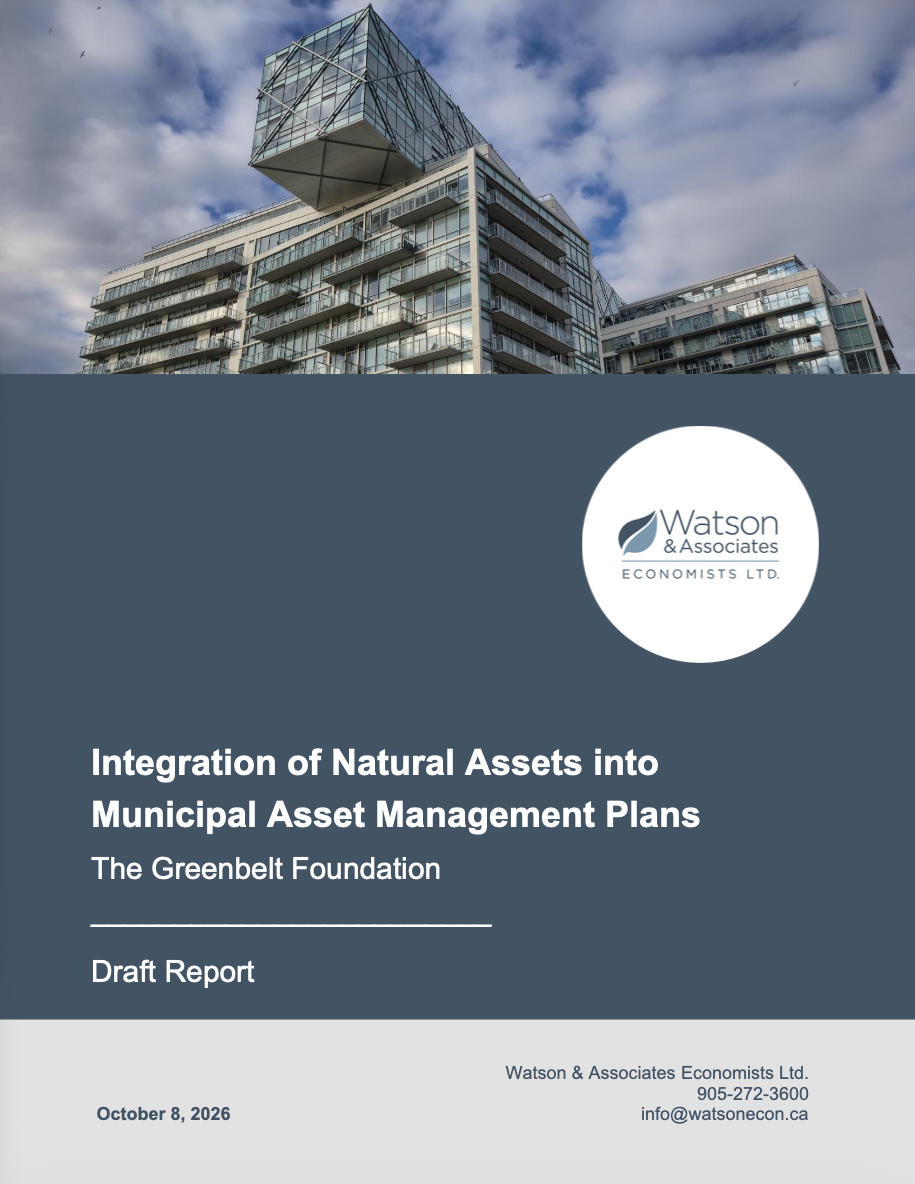
Draft cover of the 2026 Natural Asset Integration Report

Greenbelt municipalities are starting to treat natural assets like roads and pipes

Two years after Watson & Associates first benchmarked all 73 Greenbelt municipalities for the Greenbelt Foundation, its 2026 report shows twice as many with natural assets in their plans, and where Watson says the Foundation can help next.

The 2026 Natural Asset Integration Report comes out in November.

Highlights

More municipalities have taken the steps Watson measured, including those the regulation requires

O. Reg. 588/17 required every municipality to put the natural assets it owns, with their current levels of service, in its asset management plan by July 2024, and to add proposed levels of service and a lifecycle management and financial strategy by July 2025. Watson counted how many of the 73 have taken each step, and how many have used that information in a business case.

50 up from 24

municipalities, out of 73, now have natural assets in their asset management plan.

34 up from 8

have set proposed levels of service for their natural assets, the service they plan to deliver.

33 up from 16

look at the forecast cost of upkeep when they prepare the annual budget.

14 up from 4

have used natural asset information to support a business case.

Most began with the natural assets they already look after, like parks, street trees, and forests.

Barriers

Two years ago most municipalities asked how to start. Those further along now ask how to pay for the plan.

For them, the questions are about plans councils have already approved: which method to value the assets, how to defend that value, and where the money for upkeep comes from each year.

New
Council support

When looking after a wetland works, the flood doesn’t happen, so there’s nothing to point to. One council approved its natural asset plan but not the yearly money to keep the assets working, and asked what return it would get on spending that only keeps things as they are. Others support the work in principle without funding it.

Stories of making the case to council →
New
Methods

There’s no agreed way yet to value a wetland, assess a shoreline’s condition or set a level of service for a woodlot, so staff hold back numbers they can’t defend.

The methods municipalities are using (step 2) →
New
Private land

In one Greenbelt municipality, more than half the trees are on private property. An asset management plan covers what the municipality owns, but the services it counts on come from natural assets on both sides of the property line.

Who’s responsible for natural assets →
New
Priorities

Councils now weigh natural assets against housing growth, electrification and the roads budget for money, land and time. Municipalities that made progress wrote natural assets into documents such as their asset management policy, official plan or engineering guidelines, so natural assets have formal standing when council sets priorities.

What the regulation requires →
New
Software

Asset management software and GIS were built for assets with service lives and replacement costs. Inventories built from conservation authority mapping need reworking before the software can use them.

Tell us how you did it →
New
Invasives and climate

Invasive species can wear down a woodlot while it still looks healthy, and controlling them takes operating money every year. Changing temperatures and rainfall, and more wildfires and storms, also change the upkeep a natural asset needs.

Planning the upkeep (step 5) →

Get natural assets into your plan: step by step

If you look after parks or street trees, you already manage natural assets. Here’s what your plan needs, in order, and who can help at each step.

Before you start

A natural asset is any part of nature your municipality relies on, or could rely on, for a service. A wetland that holds back stormwater, a woodlot that cools a neighbourhood, and an aquifer that supplies drinking water are all natural assets, and unlike a pipe, most never reach the end of their useful life. The Natural Assets Checklist (2026) from the Greenbelt Foundation and TRCA lists fifteen types.

The fifteen natural asset types →

Ontario Regulation 588/17 treats the wetlands, woodlands, urban forests, and natural channels a municipality owns as infrastructure, under the name green infrastructure. Your asset management plan had to include them, with their current levels of service, by July 1, 2024, and add their proposed levels of service and a lifecycle management and financial strategy by July 1, 2025.

Your plan also matters for funding. The Ontario Community Infrastructure Fund, which gives grants to small, rural, and northern municipalities, asks for a link to your municipality's plan and can hold back its grant payments without one. The federal Build Communities Strong Fund requires a plan that meets O. Reg. 588/17, and asks you to report your progress on it to AMO each year.

O. Reg. 588/17: requirements and deadlines →

If you don't know where to begin, the Natural Assets Initiative's Roadmap Program takes at least three of your staff through two or three online workshops. Most municipalities finish a short action plan within four months, and the program costs $500.

The Roadmap Program

1Inventory

Inventory what you have

List the natural assets your municipality owns or relies on: what each one is, where it is, and its size. Your asset management plan has to cover the ones the municipality owns.

Your conservation authority already has much of the mapping an inventory needs, for small and large municipalities alike, and can take on more of the work under an agreement. If you hire a consultant for the inventory, you can ask for one that meets CSA W218:23, the voluntary national standard.

First action
Ask your conservation authority for the ecological land classification, wetland, and watercourse mapping it already has for your municipality. Many authorities publish some of it on an open data portal.
Example
The Natural Assets Initiative built Lincoln's first inventory, 5,588 natural assets, from maps that already existed, including Niagara Region's land classification and the conservation authority's floodplain and waterbody maps.
Selected resource
'Nature is Infrastructure' (2024), section 2.2, from the Natural Assets Initiative: choosing your data, sorting your assets, and building a registry. Free.
2Condition

Assess each one’s condition

Condition is whether the asset can keep doing its job. Built assets have engineering norms for this. Natural assets don't have a provincial benchmark yet, so record what you can observe and what your conservation authority already monitors.

First action
Ask your conservation authority what monitoring it already does on land your municipality owns, and whether it could assess condition there under an agreement.
Example
In 2024 Peel Region assessed the condition of 18,678 trees, shrub clusters, and woodland patches on its land, working with its conservation authorities. About 45 percent of the forested areas were in poor or very poor condition, mostly because of invasive species.
Selected resource
Credit Valley Conservation's 'Business Case for Natural Assets in the Region of Peel' (2020), appendices A to C: a rapid condition assessment method and score calculator for municipal staff with no background in ecology, which flags the assets that need an ecologist's look. Free.
3Service

Set the level of service

In your asset management plan, say what each natural asset should deliver, such as how much stormwater a wetland holds in a storm. The regulation requires the current level of service and a proposed one, with the cost of the proposed level, the funding the municipality expects to have, and what it will do if that falls short. Asset Management Ontario (AMONTario) runs training on setting levels of service.

First action
Read the City of London's slides on levels of service for urban woodlands, from Asset Management Ontario's 2021 workshop. Then draft one service measure for one natural asset you manage.
Example
In 2025 Brampton proposed its first levels of service for natural assets: keep today's wetland area, and good water quality in every lake by 2034.
Selected resource
The Town of Fort Erie's 'State of Infrastructure Report: Natural Assets in the Town of Fort Erie' (2024), by Green Analytics with the Niagara Peninsula Conservation Authority: service measures for a town's own wetlands, forests, and street trees, set alongside their condition and risk. Free.
4Value

Put a replacement cost on it

O. Reg. 588/17 asks for the replacement cost of each asset category, which you build up asset by asset. For a natural asset, the simplest version is the average cost to restore one hectare of the same type, times the asset's area. What it would cost to build a pipe or pond to do the same job is a different figure, and it measures the service the asset provides rather than the asset itself.

The Natural Assets Initiative explains how to estimate a restoration cost in its guide 'Nature is Infrastructure' (2024). Your conservation authority may have restoration costs to share.

First action
Email Credit Valley Conservation at naes@cvc.ca for the spreadsheets behind its 2025 replacement and lifecycle costs per hectare.
Example
Markham's 2025 asset management plan gives a one-time replacement cost per hectare for each natural asset type, such as $173,847 for deciduous forest, for a total of $169.5 million for the woodlands, meadows, wetlands, and hedgerows among the 986 hectares the city owns.
Selected resource
Credit Valley Conservation's 'Natural and Enhanced Asset Lifecycle and Replacement Costing' (2025): 50-year lifecycle and replacement costs per hectare for 22 natural asset types common in southern Ontario. Free.
5Council

Plan the lifecycle and take it to council

List the work each natural asset needs over the next ten years, such as removing invasive plants, repairing eroded banks, replanting, and monitoring, and what each costs a year. Check the numbers with your treasurer, then put them in the plan's ten-year financial strategy. The municipality's executive lead endorses the plan, and council approves it, strategy included.

First action
Ask your finance staff what the municipality already spends each year on invasive species control, erosion repair, and planting in natural areas.
Example
Halton Hills costed three ways to manage its green assets over ten years. In July 2026 council approved the middle option in principle, at about $800,000 more a year, to be phased in.
Selected resource
'Natural Asset Management: Advancing Policy Innovation and Municipal Leadership' (2025), written by Asset Management Ontario for the Greenbelt Foundation: 24 actions a council can take, including questions on budgets and reserve funds. Free.

Natural asset management terms

The words the regulation, CSA standard, and consultants use, with a note on which meaning this site uses when they differ. If a term is missing or wrong, tell us.

No matching term. Add the term you were looking for.

Core organizations

Seven organizations offer most of what you'll need to start or to move forward. Between them they cover inventory data, methods, training, peer advice, and financial reporting.

Starting an inventory
Your conservation authority
Public agencies

Ontario has 36 conservation authorities, organized by watershed, and they merge into nine regional authorities on February 1, 2027. They collect much of the data a natural asset inventory needs, for municipalities of every size, and take on further natural asset work under agreement with a municipality. Find yours through Conservation Ontario.

Methods and guidance
Natural Assets Initiative
National non-profit

Works with local governments across Canada on natural asset management. Its guide 'Nature is Infrastructure' (2024) sets out how to put natural assets into an asset management plan. Its Roadmap Program has helped more than 100 local governments and conservation agencies set out their first steps.

Training and peers
Asset Management Ontario
Practitioner community

An association of Ontario's public sector asset managers. It runs webinars and training, including a stream on climate change and green infrastructure.

Comparing notes with other municipalities
Community of practice on natural asset management
Practitioner community, with the Greenbelt Foundation as a partner

Asset Management Ontario describes itself as a community of practice of public sector asset managers, and the Greenbelt Foundation lists it among the partners in its natural asset management program. Its members compare how they've inventoried, costed, and funded natural assets. To take part, write to info@amontario.ca.

Budgets and financial reporting
Municipal Finance Officers' Association
Professional association

Ontario's association for municipal finance staff. It co-funded 'Nature is Infrastructure' (2024) and runs a course on bringing natural assets into an asset management plan.

Policy and advocacy
Green Infrastructure Ontario Coalition
Coalition

A coalition of organizations that advocates for green infrastructure policy in Ontario.

Research across the region
Greenbelt Foundation
Charitable foundation

Since 2020 the Foundation has run a natural asset management program through grants and partners. With the Municipal Finance Officers' Association of Ontario it funded 'Nature is Infrastructure' (2024), and it commissions Watson & Associates' monitoring of all 73 Greenbelt municipalities, reported in 2024 and again this fall. It runs this site.

Who’s responsible for natural assets

Your municipality
Your municipality owns the assets and writes the plan. O. Reg. 588/17 requires it to name who is responsible for asset management planning, with an executive lead who endorses the plan. Council approves the plan by resolution and reviews progress every year by July 1, and the treasurer ties it to the budget.
Your conservation authority
Your conservation authority must deliver programs on natural hazards, its own lands, drinking water source protection, provincial water monitoring, and a watershed strategy. Work on your natural assets, such as an inventory, is extra, and the authority does it under an agreement with you. It also has the watershed science an inventory needs.
The Province
The Province sets the rules the plan must meet, through O. Reg. 588/17, and the land use framework the regulation requires your policy to align with: the Provincial Planning Statement, provincial plans such as the Greenbelt Plan, the Oak Ridges Moraine Conservation Plan and the Niagara Escarpment Plan, and your official plan. It has published no method for assessing natural asset condition.
Everyone else
Everyone else supports rather than owns. The Natural Assets Initiative supplies the method, Asset Management Ontario the training and peers, the Federation of Canadian Municipalities' programs the funding, and Watson & Associates the study.

How an organization gets listed here →

NAM in the wild

Examples of municipalities putting a natural asset into their planning, and what it took.

No story for that barrier yet. Add what your municipality did.

Add what your municipality did

About this site

What this is, who runs it, and how to help it grow.

What this is

Namual is a shared reference for the staff who manage natural assets in the Greenbelt's 73 municipalities. It covers the practice in plain language, the terms, the organizations that can help, and what municipalities did.

The figures

The figures on the home page are from Watson & Associates Economists’ 2026 assessment of all 73 Greenbelt municipalities for the Greenbelt Foundation, which repeats Watson’s 2024 assessment. They count gains only, because Watson scored each municipality on its best evidence and no score fell between 2024 and 2026. The method is in the report.

Who it's for

It's for staff in asset management, public works, finance, or planning in one of the Greenbelt's 73 municipalities, for the CAOs who take that work to council, and for the conservation authority staff and consultants those municipalities call on.

Firsts

In 2014 the Town of Gibsons, BC became the first municipality in North America to name natural assets as an asset class in its asset management policy. Three years later Ontario became the first province to regulate municipal asset management planning, with a regulation that treats the green infrastructure a municipality owns, including its natural features, as municipal infrastructure.

Who runs it

The Greenbelt Foundation convenes the partners behind it. The Foundation commissions the research that monitors natural asset management across the 73 municipalities and works with the organizations listed under Core organizations.

Help grow Namual

Municipal staff, conservation authorities, and consultants can send terms, resources, stories, assets, and organizations. The Foundation checks each one before it goes up, so it won't appear straight away.

Add to this site →

Listing your organization

An organization appears under Core organizations if it works on natural asset management in Ontario and the Greenbelt Foundation works with it. The Foundation is asking each one to describe itself in its own words. Until then, the descriptions come from their own websites and publications.

Suggest an organization →

Updates

The glossary and Core organizations change as contributions are approved. The Foundation will publish Watson’s 2026 findings here this fall, and they stay up as web pages.

Using and citing

You’re welcome to use anything original on Namual in staff reports, council presentations and training, as long as you credit it. For other uses, ask the Foundation at greenbelt.ca/contact.

Cite it as Namual, Greenbelt Foundation, with the date you read it.

Add to this site

Send a term, a resource, what your municipality did, a natural asset, or an organization.

Is this page useful? Report a problem with this page